


Quiet marketing is a business growth strategy that relies on owned, evergreen channels — SEO, blogging, Pinterest, email marketing, and collaborative partnerships — instead of social media or high-visibility personal branding. It prioritizes sustainable visibility over constant content creation, and it’s specifically designed to work with introvert energy rather than against it.
I didn’t invent the idea of marketing without social media. But I did name it, build a business around it, and prove that it works — after ditching social media completely in 2022 and watching my business keep growing anyway. What I use instead are the tools that have always worked quietly in the background, compounding over time, attracting the right people without requiring me to perform for an algorithm every single day.
Disclaimer: I earn from qualifying purchases. Some of the links on my website are affiliate links, which means, at no additional cost to you, I will earn a small commission if you click through and make a purchase.
If you’ve been told that visibility requires constant posting, endless reels, or showing up live multiple times a week, this post is going to feel like a relief. Quiet marketing is a real strategy, it produces real results, and it might be exactly what your business has been missing.
What Quiet Marketing Actually Means (And What It Doesn’t)
Quiet marketing is not a shortcut, a passive income fantasy, or an excuse to avoid doing the work. It’s a deliberate choice to build your visibility on channels you own and control, using content that keeps working long after you create it, without needing you to show up and perform every single day to stay relevant.
The “quiet” part refers to the approach, not the results. You’re not whispering into the void hoping someone finds you. You’re building a system where the right people find you consistently, through search engines, through referrals, through email, and through strategic relationships… all without you being tethered to a social media feed.
What quiet marketing is not:
- It’s not anti-visibility. You’re still building an audience, growing a list, and showing up for your people. You’re just doing it in ways that don’t require daily content creation or platform dependency.
- It’s not slow by accident. The channels quiet marketing relies on take time to build, but they compound. A blog post written today can drive traffic for years. An email list you grew last year keeps converting long after the posts that built it have disappeared from someone’s feed.
- It’s not only for introverts, though introverts tend to thrive with it. Anyone who’s burned out on the performance side of social media, or who simply wants a more sustainable marketing rhythm, can benefit from this approach.
The loudest marketers aren’t always the most successful ones. Some of the most profitable online businesses are built by people you’ve never seen on a trending audio, and that’s not a coincidence.
What Are the Core Channels of Quiet Marketing?
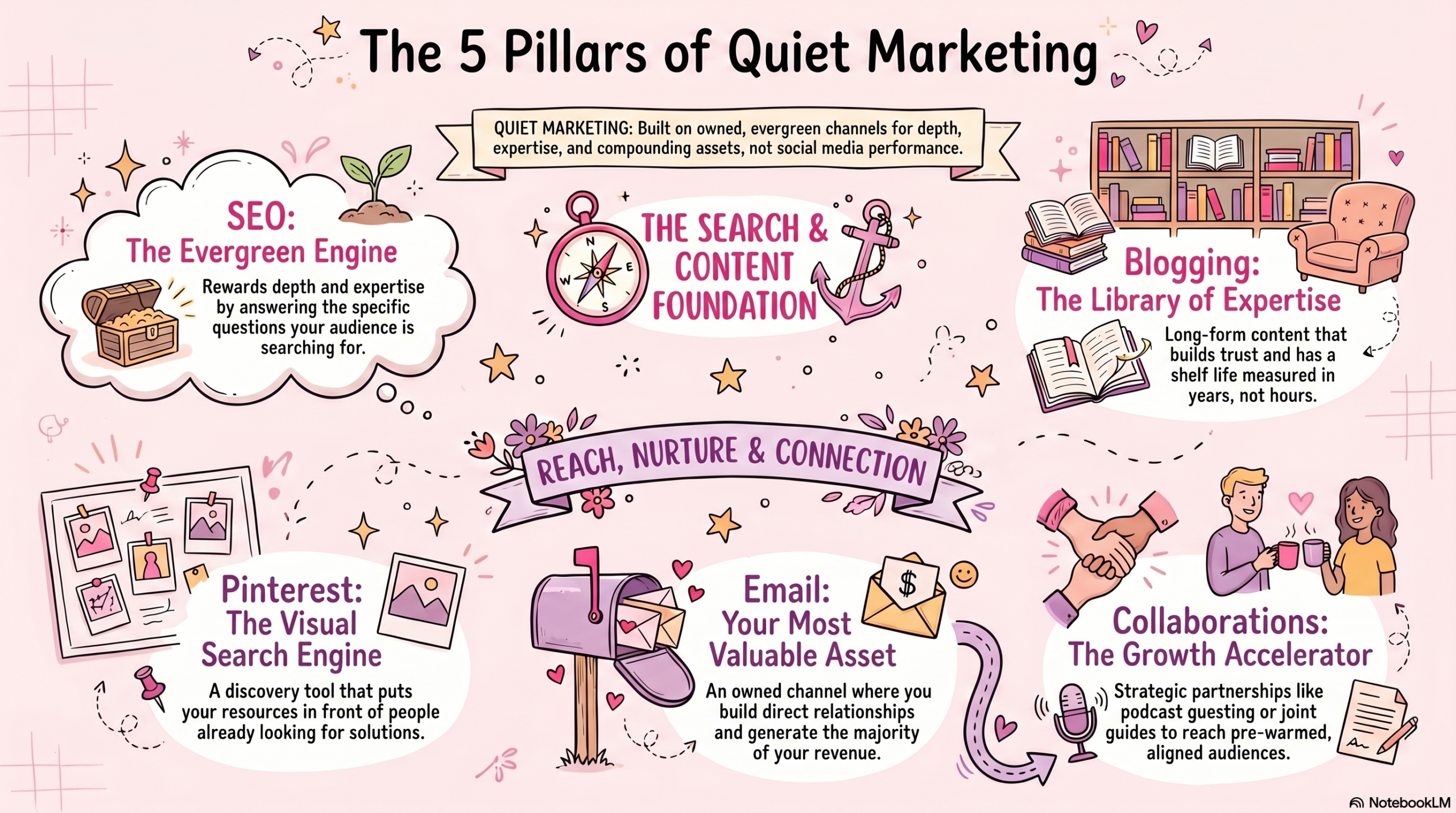
Quiet marketing is built on five channels.
Each one is evergreen, algorithm-resistant, and designed to keep working without requiring your constant attention. Here’s a breakdown of what they are and why they work so well for introverted entrepreneurs.
1) SEO (Search Engine Optimization)
SEO is the foundation of quiet marketing. When someone types a question into Google, you want your content to be the answer they find. A well-optimized blog post or page can drive consistent, targeted traffic to your site for months or years without you doing anything after you hit publish. It’s the closest thing to a marketing system that genuinely runs in the background, and it rewards depth, clarity, and expertise — all things introverts tend to do really well.
According to Animalz research, top-performing evergreen content often holds a top 10 Google ranking for two years or more before experiencing noticeable traffic decline.
2) Blogging
Blogging is how SEO comes to life.
Long-form content lets you go deep on topics your audience is actively searching for, build trust over time, and create a library of resources that keeps attracting new readers. Unlike social media posts that disappear within hours, a strong blog post has a shelf life measured in years.
It also gives you something to link to, reference in emails, and share without starting from scratch every time you want to communicate something.
3) Pinterest
Pinterest is one of the most underrated quiet marketing channels available, and it tends to surprise people when they learn how much traffic it can drive.
Pinterest is a search engine, not a social media platform. People go there looking for ideas, solutions, and resources — which means your content is being discovered by people who are already looking for exactly what you offer. Pins have an exceptionally long lifespan compared to any social media post, and the platform rewards consistency over virality.
4) Email Marketing
Your email list is the most valuable asset in your quiet marketing system because you own it completely. No algorithm decides who sees your emails. No platform can take it away from you.
A well-nurtured email list is where your audience becomes your community, where trust deepens over time, and where the majority of your revenue is generated. Quiet marketing treats email not as a broadcast tool but as an ongoing relationship, and that distinction matters more than most people realize.
5) Collaborative Partnerships
This is the channel that often gets overlooked in conversations about marketing without social media, and it’s one of the most powerful ones in the quiet marketing toolkit.
Strategic collaborations — things like co-created free guides, virtual summits, podcast guest appearances, and newsletter features — put you in front of aligned, pre-warmed audiences without requiring you to build that audience from scratch yourself. When done well, a single collaboration can add hundreds or thousands of people to your list, and the relationship-first nature of collaboration aligns naturally with how most introverts prefer to connect and grow.
These five channels work individually, but they work best together. SEO and blogging drive discovery. Pinterest amplifies reach. Email nurtures and converts. Collaborations accelerate growth. That’s the quiet marketing system in action.
Why Quiet Marketing Works for Introverted Entrepreneurs
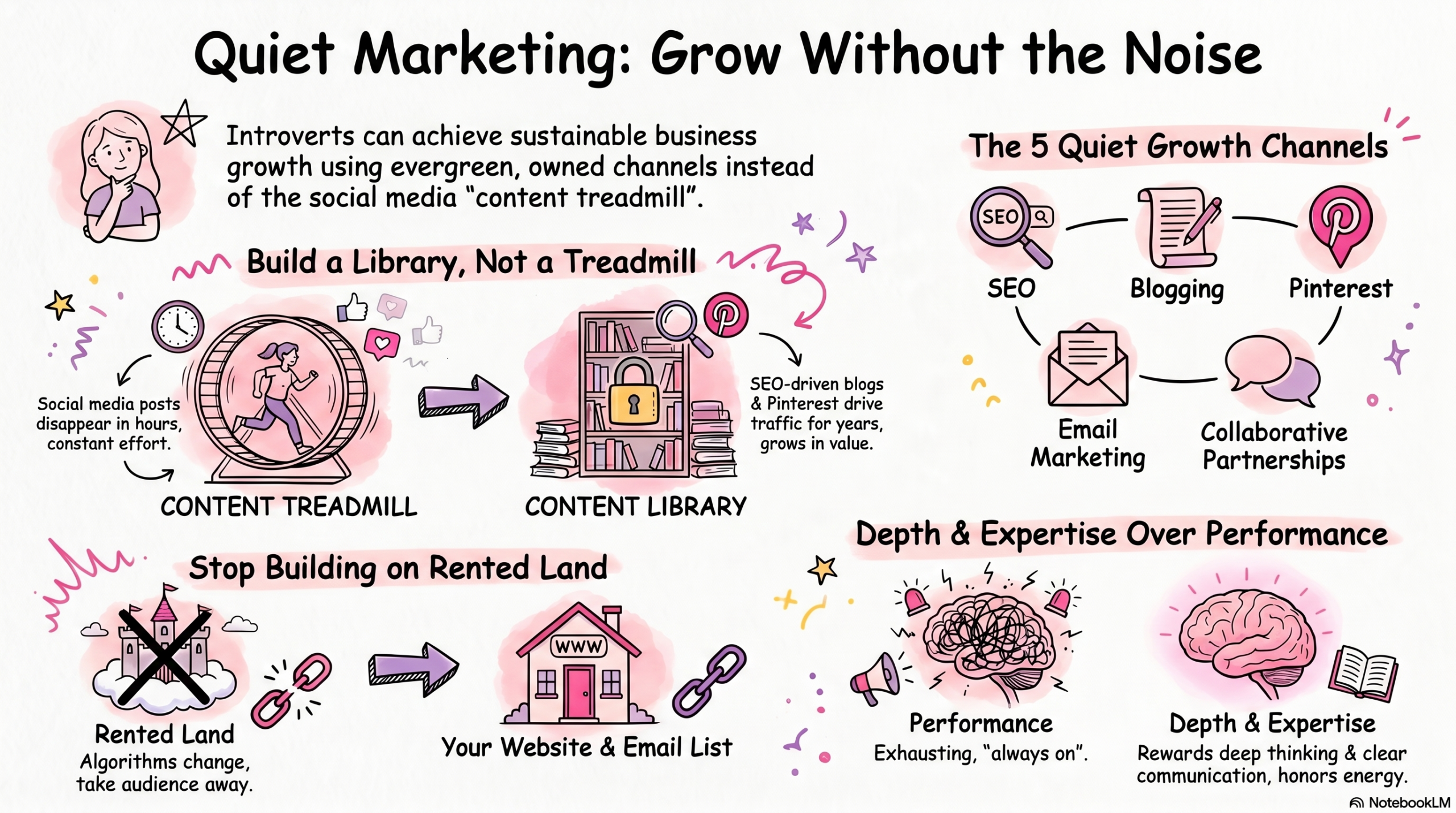
There’s a reason introverted entrepreneurs tend to feel so at home with this approach once they find it.
Quiet marketing isn’t just a workaround for people who don’t like social media — it’s a strategy that’s genuinely built around the strengths introverts already have in abundance.
It rewards depth over volume.
Social media rewards frequency. The more you post, the more the algorithm favors you, which means the game is designed for people who can produce content at a relentless pace.
Quiet marketing rewards something different: depth, expertise, and the ability to communicate clearly and thoroughly on a topic. A 2,000-word blog post that genuinely answers someone’s question will outperform a hundred quick-take social posts every time when it comes to long-term organic traffic.
Introverts who love going deep on topics they care about are naturally wired for this.
A 2024 Mentally Healthy Survey of over 2,000 professionals found that 70% of people across media, marketing, and creative sectors reported experiencing burnout in the past 12 months.
It doesn’t require performance.
One of the most draining parts of social media marketing for introverts isn’t the content creation itself — it’s the performance layer on top of it. The expectation to be “on,” to respond in real time, to project energy and enthusiasm publicly and consistently.
Quiet marketing removes that layer entirely. You’re creating content, not performing. You’re writing, building, and strategizing — all things that tend to feel energizing rather than depleting for people who do their best thinking away from an audience.
A 2025 study by Influencer Marketing Hub found that 68% of creators cite algorithmic pressure as a major stressor.
It’s built on owned assets, not rented platforms.
Introverts tend to think long-term. They’re not usually chasing the quick hit or the viral moment — they’re building something that lasts.
Quiet marketing aligns with that instinct because it’s rooted in assets you own and control: your website, your blog, your email list. I ditched social media completely in 2022 and my business kept growing, and the reason that was possible is because I had spent years building on a foundation that didn’t depend on any platform’s goodwill or algorithm changes. When you build on owned channels, you’re not at the mercy of a platform deciding to change the rules on you overnight.
It’s sustainable by design.
Burnout is real in the entrepreneurship space, and it disproportionately affects people who are pushing themselves to market in ways that don’t fit their energy.
Quiet marketing is designed to be sustainable — not because it’s easy or effortless, but because the work you put in compounds over time rather than expiring. You’re not on a content treadmill where stopping means everything dries up. You’re building a system where momentum accumulates, and that changes the relationship between your energy and your results in a meaningful way.
HubSpot’s 2025 State of Blogging Report found that 50% of marketers from businesses that maintain blogs saw higher ROI from blogging in 2024 compared to 2023.
The entrepreneurs I work with who make the shift to quiet marketing almost universally say the same thing: it’s not just that it works, it’s that it finally feels like a strategy they can actually sustain. That matters, and it’s not a small thing.
How Is Quiet Marketing Different from Traditional Marketing?
Most mainstream marketing advice is built around visibility at volume. Post more, show up more, be everywhere at once. The underlying assumption is that attention is the goal, and the more of it you capture, the more successful your business will be.
Quiet marketing operates from a completely different set of assumptions, and understanding the distinction helps explain why so many introverted entrepreneurs feel exhausted by traditional advice even when they’re technically following it.
Here’s how the two approaches compare across the dimensions that matter most.
Where the traffic comes from
Traditional marketing, especially social-media-first marketing, relies on interruption. Your content appears in someone’s feed while they’re scrolling, and the goal is to stop them long enough to engage. The traffic is real but it’s fragile — it depends on consistent posting, platform favorability, and timing.
Quiet marketing relies on intention. People find your content because they were already looking for it. They searched for something, your blog post or Pinterest pin appeared, and they clicked because it matched what they needed.
That difference in how someone arrives on your site changes everything about how warm they are and how likely they are to convert.
What the work looks like day to day
Traditional marketing creates a content treadmill. You need to keep posting to stay visible, which means the moment you slow down, your reach drops. There’s no finish line, no compounding, and no rest — just an ongoing obligation to produce at pace.
Quiet marketing creates a content library. The blog post you wrote two years ago is still ranking. The email sequence you built last year is still nurturing new subscribers. The collaborative guide you launched eighteen months ago is still sending you traffic. The work you do today keeps paying off for a long time, which means your effort compounds rather than expires.
Who controls the rules
With traditional social media marketing, the platform controls the rules and changes them without warning. Algorithm updates, reach changes, format shifts — these can significantly affect your results overnight and there’s nothing you can do about it. You’re building on rented land, and the landlord can change the terms at any time.
With quiet marketing, you own the foundation. Your website, your blog content, your email list — these belong to you. No platform can take them away or decide to show them to fewer people. That ownership creates a kind of stability that social-media-first strategies simply can’t offer.
What it asks of you
Traditional marketing asks for constant presence, real-time engagement, and a level of extroverted performance that feels unnatural to a lot of people. It rewards those who can produce quickly, respond publicly, and maintain a visible, energetic persona across multiple platforms simultaneously.
Quiet marketing asks for strategic thinking, patience, and the ability to create content with depth and clarity. It rewards people who can communicate well in writing, who think long-term, and who are willing to build something over time rather than chase immediate attention. For most introverted entrepreneurs, that’s not a compromise — it’s a relief.
The point isn’t that traditional marketing never works. It’s that quiet marketing works differently, and for a specific kind of business owner, it works better — because it’s built around how they actually think, create, and connect.
How to Get Started With Quiet Marketing

The most common mistake people make when they discover quiet marketing is trying to implement all five channels at once. That’s not the quiet marketing approach — that’s just trading one form of overwhelm for another. Getting started well means choosing your foundation first and building from there.
Here’s how to approach it in a way that’s actually sustainable.
1) Start with your home base.
Before anything else, you need a website and a blog. This is where everything else points back to. Your SEO content lives here, your opt-in forms live here, your offer pages live here. If your website isn’t set up to capture email addresses and convert visitors into subscribers, the traffic you build through other channels has nowhere to go.
Get that foundation solid before you focus on driving more people to it.
2) Choose one discovery channel and go deep on it.
SEO-driven blogging and Pinterest are the two main discovery channels in the quiet marketing system, and you don’t need both right away. Pick the one that feels most aligned with how you like to create content and commit to it consistently for at least six months before evaluating results.
SEO blogging tends to be the stronger long-term foundation for most business types, but Pinterest can drive faster initial traffic, especially for visual niches. Either way, consistency over time matters far more than trying to do both at once.
3) Build your email list from day one.
You don’t need a large audience to start building your list — you just need a compelling reason for someone to hand over their email address. A focused free resource, a short guide, a quiz, a checklist — something specific enough to feel genuinely useful to your ideal reader.
Your email list is the most important asset in your quiet marketing system and it grows alongside everything else, so the earlier you prioritize it, the better.
4) Add collaborations once you have something to send people to.
Collaborative partnerships are one of the fastest ways to grow your email list and your audience reach, but they work best once you have a clear opt-in offer and a home base that’s ready to receive new visitors. Once those are in place, start building relationships with other entrepreneurs in aligned but non-competing spaces.
A co-created guide, a podcast guest appearance, or a newsletter feature can put you in front of hundreds of new people at once — people who arrive already warmed up because someone they trust introduced you.
5) Give it time.
This is the part that requires the most patience and the most trust.
Quiet marketing doesn’t produce overnight results, and that’s actually part of why it works so well long-term. The channels that take time to build are also the channels that keep compounding. A blog post that takes three months to rank can drive traffic for three years. An email list that takes a year to build becomes the most reliable revenue driver in your business.
The timeline feels slower at first, but the return on that investment is fundamentally different from anything you’ll get from a social media strategy.
If you want to see exactly how I put these channels together in practice — what I actually do each week, month, and quarter to keep my business growing without social media — the Quiet Marketing Playbook walks through the whole system. It’s free, it’s specific, and it’s a good first look at how quiet marketing works as a complete system rather than a collection of individual tactics. You can grab it at thetarareid.com/playbook.
Final Thoughts
Quiet marketing exists because there is genuinely another way to build a visible, profitable business. And it’s one that doesn’t require you to be everywhere, perform constantly, or build on platforms you don’t own. It’s not a trend or a reaction to social media burnout, even though a lot of people find it at that moment. It’s a complete, strategic approach to visibility that happens to align naturally with how introverted entrepreneurs think, work, and connect.
The five channels — SEO, blogging, Pinterest, email marketing, and collaborative partnerships — work together as a system. Each one supports the others, and over time the whole thing compounds in a way that a social-media-first strategy simply can’t replicate.
You build something that keeps growing even when you step away from it, and that changes the relationship between your time, your energy, and your results in a way that’s hard to overstate.
If you’re ready to see what quiet marketing looks like as a complete weekly and monthly system, the Quiet Marketing Playbook is the best place to start. It’s a free download that walks through exactly what I do to market my business in under five hours a week — no social media required.
Grab your copy at thetarareid.com/playbook and see whether this approach feels like the right fit for where you want to take your business.
FAQ About Quiet Marketing
Quiet marketing is a business growth strategy that relies on owned, evergreen channels — SEO, blogging, Pinterest, email marketing, and collaborative partnerships — instead of social media or high-visibility personal branding. It prioritizes sustainable visibility over constant content creation and is designed to work with introvert energy rather than against it. The term was coined by Tara Reid, a business and marketing strategist who has built her business entirely without social media since 2022.
Quiet marketing is a specific type of organic marketing, but the two terms aren’t interchangeable. Organic marketing broadly refers to any marketing that doesn’t involve paid advertising, including social media content. Quiet marketing is more specific — it focuses exclusively on owned, algorithm-resistant channels and intentionally excludes social media as a primary growth strategy. The distinction matters because the approach, the channels, and the energy required are meaningfully different.
Yes, with realistic expectations about timeline. The channels quiet marketing relies on — particularly SEO and blogging — take time to build momentum, so a brand new business should expect to invest consistently for several months before seeing significant organic traffic. That said, email list building and collaborative partnerships can produce faster results in the early stages. The key is starting with a solid home base, a compelling opt-in offer, and a commitment to one discovery channel before expanding.
The honest answer is that it depends on your starting point, your niche, and how consistently you show up. Most people start seeing meaningful SEO traction within three to six months of consistent blogging, with results compounding significantly in the first one to two years. Email list growth through collaborations can happen faster. The timeline feels slower than social media in the beginning, but the results last significantly longer and require less ongoing effort to maintain.
Social media marketing is built on interruption, platform dependency, and constant content creation. Quiet marketing is built on intention, owned assets, and content that compounds over time. With social media marketing, your visibility is tied to how often you post and how the algorithm treats you on any given day. With quiet marketing, your visibility is tied to a library of content and a list you own outright — neither of which disappears when you take a week off or when a platform changes its rules.
Quiet marketing works at every list size, including zero. In fact, building your email list is one of the core goals of the quiet marketing system, not a prerequisite for starting it. SEO-optimized blog content, Pinterest traffic, and collaborative partnerships are all designed to bring new people into your world and onto your list over time. You don’t need a large list to begin — you just need a clear opt-in offer and a consistent strategy for driving people to it.

Tara Reid is a business and marketing strategist for introverted and multipassionate entrepreneurs. She has been an online entrepreneur since 2007 and left social media completely in 2022, growing her business instead through SEO, blogging, email marketing, Pinterest, evergreen funnels, and collaboration. She helps coaches, course creators, and service providers grow sustainable income without performing for an algorithm.
As the founder of the Introvertpreneur Club, Tara’s mission is to show heart-centered entrepreneurs that you don’t have to be loud to be successful. You just need the right strategies that fit your personality.
When she’s not supporting clients or creating new resources, you can find her at home in Canada with her three rescue dogs, a cup of coffee in hand, dreaming up her next project.




This one's on me. Complimentary free stuff coming right up.
leaving so soon?
Look behind the curtain and see exactly what I do every week, month, and quarter, to market my business without social media (in under 5 hours per week)!
The Quiet Marketing Playbook

Take this free quiz and learn what your superpower is as an entrepreneur. You'll also get a curated list of my best resources and tips for using your superpower to your advantage!
What's your Introverted Superpower?

Best Free Resources:
dig into 'em now!