





If you have a blog, there’s a good chance you’re sitting on a goldmine you haven’t touched in years. Old blog posts that were written quickly, never properly optimized, or built for a version of your business that no longer exists — they’re still out there, still technically live, and still capable of doing real work for you if you give them a little attention.
Most content advice pushes you to keep creating. New posts, new topics, new angles. And yes, fresh content matters.
Disclaimer: I earn from qualifying purchases. Some of the links on my website are affiliate links, which means, at no additional cost to you, I will earn a small commission if you click through and make a purchase.
But the truth is that one well-refreshed post can outperform five new ones, because you’re not starting from scratch. You already have the URL, whatever search authority the page has accumulated, and a topic that clearly meant something to you at some point. You just need to bring it up to the standard your business is at now.
This is exactly what a group of Introvertpreneur Club students did during April’s Get It Done Week, and the results were genuinely impressive. Below, we’ll talk about what a blog refresh actually involves, why it matters for SEO, AEO, and GEO, and then hand things over to the students themselves so you can see what this looks like in practice.
- Why Old Blog Posts Are Worth Your Attention
- What SEO, AEO, and GEO Actually Mean
- What a Real Blog Refresh Actually Looks Like
- See It in Action: April’s Get It Done Week Results
- How to Approach Your Own Blog Refresh
- Final Thoughts
- Frequently Asked Questions
- How often should you refresh old blog posts?
- Does updating an old blog post help with SEO?
- What is the difference between AEO and GEO?
- What should I fix first when refreshing a blog post?
- Do I need to rewrite the whole post when refreshing it?
- Can refreshing a blog post hurt my rankings?
- What is Google Search Console and do I need it?
Why Old Blog Posts Are Worth Your Attention
There’s a version of content strategy that treats old posts like finished products — published, done, move on. But that framing doesn’t account for how search actually works, or how much your business changes over time.
A post you wrote in 2019 might be ranking for a keyword you no longer care about, pointing readers to an offer you no longer sell, or missing an internal link to a newer post that would serve them better. It might have no images, no clear structure, and a CTA that makes no sense given where your business has gone. Technically it’s live. In practice, it’s doing very little.
Refreshing that post means giving it a reason to rank and a reason to convert. Search engines like Google re-crawl updated content and factor freshness into rankings. A post with a more accurate meta description, a stronger keyword focus, proper header hierarchy, and current internal links is going to perform better than the same post left untouched — even if the core topic is identical.
Beyond Google, there’s the question of what happens when someone lands on your site from any source and finds content that doesn’t match the quality or voice of your current brand. Outdated posts can quietly undermine trust. A refreshed post, though, signals that you’re active, authoritative, and still engaged with the topic — which matters to readers and to search algorithms alike.
What SEO, AEO, and GEO Actually Mean
These three acronyms get thrown around a lot, and they do overlap, so it’s worth being clear on what each one actually covers.
SEO (Search Engine Optimization)
This is the foundation. It’s about helping individual pages rank in Google when someone searches a specific keyword. Strong SEO means your titles, headers, meta descriptions, and body copy reflect what people are actually searching for, and that your site structure (internal links, load speed, mobile formatting) gives Google every reason to surface your content.
AEO (Answer Engine Optimization)
This goes a step further. Instead of optimizing for rankings, you’re optimizing for answers — specifically, the kind of direct, structured answers that AI-powered tools like ChatGPT, Perplexity, and Google’s AI Overviews pull when someone asks a question. Content that’s clear, well-structured, and written in natural conversational language is more likely to get referenced in those AI-generated responses.
GEO (Generative Engine Optimization)
And this is the broadest layer. It’s about how AI tools understand and represent your entire brand, not just one page. If your content, your About page, your guest posts, and your collaborations all reinforce the same clear message about who you are and what you do, AI is more likely to associate you with that topic when generating recommendations.
The reason a blog refresh matters across all three is that the same improvements tend to strengthen all of them at once. Fixing your keyword focus helps with SEO. Adding proper header structure and FAQ sections helps with AEO. Creating a clearer, more consistent voice and stronger internal linking helps with GEO. One piece of work, compounding in multiple directions.
What a Real Blog Refresh Actually Looks Like
A blog refresh isn’t a full rewrite in every case, though sometimes that’s exactly what’s needed. More often, it’s a targeted audit where you look at the page through a fresh set of eyes and ask: what’s missing, what’s outdated, and what’s actively hurting this post’s ability to do its job?
Here are the improvements that tend to move the needle most:
Keyword Focus
Many older posts were written without a clear target keyword, or with a keyword that no longer fits your audience. Choosing one focused keyword and making sure it appears in your title, introduction, at least one H2, and naturally throughout the body makes a real difference. Don’t stuff it — just be intentional.
Header Hierarchy
A clear H1/H2/H3 structure helps Google understand your content and helps readers scan it. If your older posts are a wall of text with no subheadings, or have headings that don’t logically build on each other, restructuring them is one of the highest-impact changes you can make.
Internal Links
Every blog post is an opportunity to guide readers deeper into your site and help search engines understand how your content connects. If you’ve written related posts since this one went live, link to them. And look for opportunities to link back to this post from newer ones.
Images and Alt Text
Images improve readability and break up long sections of text. Alt text makes those images accessible and gives you another opportunity to signal what the post is about to search engines. If your older posts have no images, or have images with no alt text, this is a quick fix worth making.
CTAs
An old post might be sending readers to an offer you no longer sell, a freebie that’s outdated, or nowhere at all. Updating the CTA to reflect your current offers — and placing it thoughtfully rather than just tacking it on at the end — can meaningfully improve the conversion rate of traffic you’re already getting.
Meta description and Slug
These are small but worth reviewing. A meta description that clearly communicates what the post is about (and gives someone a reason to click) improves your click-through rate from search results. A clean, keyword-informed slug helps with both SEO and readability.
And if you want to take your blog refresh further — or build a repeatable system for writing, optimizing, and distributing posts from here on out — the Claude Blogger’s Bundle is worth a look. It’s seven installable Claude skills that handle the parts of blogging that tend to eat the most time: keyword research, outlines, intros, SEO audits, Pinterest pins, content repurposing, and GEO + AI search optimization.
One post runs through all seven tools and comes out the other side actually ready to do its job. It’s a one-time purchase at $97, works with free Claude accounts, and Club students get it included.
See It in Action: April’s Get It Done Week Results
Every month inside the Introvertpreneur Club, students complete a Get It Done Week — a focused, community-supported sprint built around one specific task. April’s theme was blog post refreshes, and five students completed the challenge and submitted their updated posts for a feature.
What they did — and what they said about the results — is worth reading.
Nicole Gelormini, Human Design Psychologist hdpsychologist.com
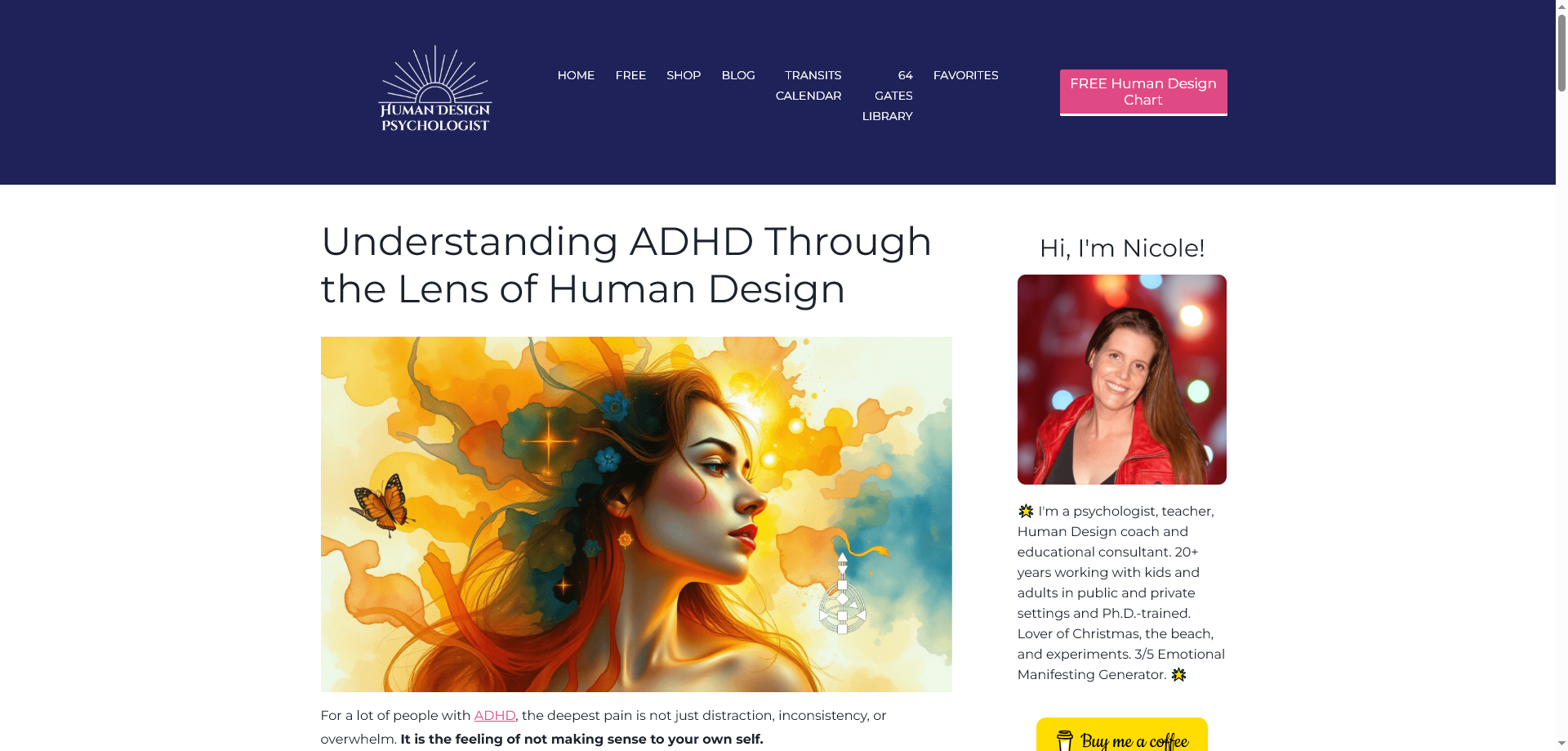
Nicole’s original post on human design for ADHD had no images, no links (internal or external), and wasn’t even indexed in Google Search Console — meaning Google didn’t know it existed. She rewrote the entire thing, added images with alt text, built out a proper linking structure, submitted it for indexing, and added two CTAs, one of which points to a brand-new lead magnet she created as part of the refresh.
In her own words: “It seems to represent a more focused and evolved perspective on the same topic that I started writing about two years ago.”
Sara Obando, Stargazed Studio stargazedstudio.com

Sara’s refresh of her WordPress plugins post involved SEO tweaks, a content restructure, a table of contents, more internal links, and a CTA update to reflect where her business is now. The original post felt generic. The updated version is aligned with her offer and her voice.
She shared: “It is so much better — by a lot. I wish I had the time to go do this same process to a lot of other posts in my blog, especially older ones that need the extra TLC. But at least I have a better process now for updating them.”
She’s even considering recording herself doing another refresh so her assistant can learn the process — which is a genuinely smart systems move.
Sarah Fournier, Caffeine and Conquer caffeineandconquer.com
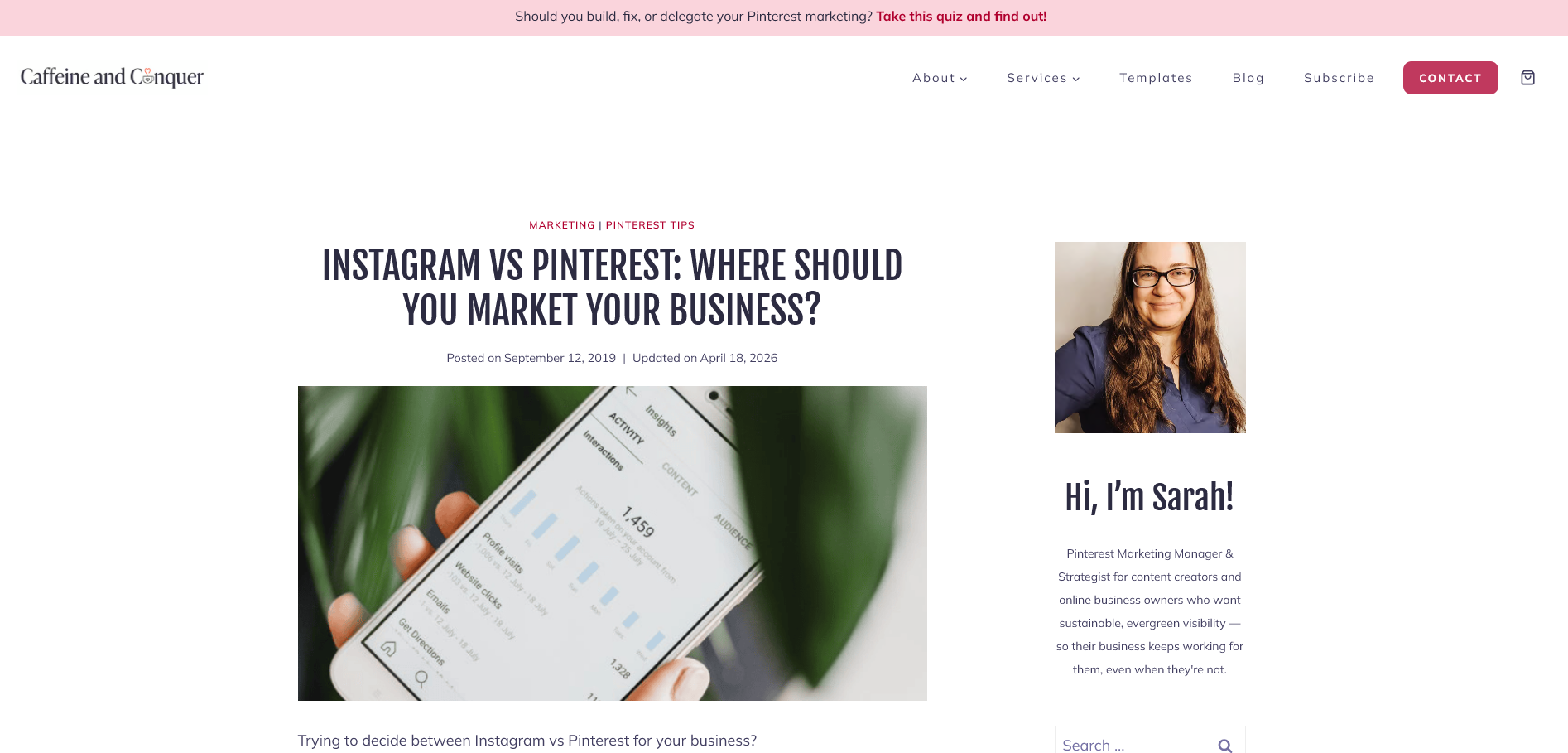
Sarah’s post on Instagram vs. Pinterest marketing was originally written in 2019 and was targeting bloggers instead of business owners — a positioning mismatch with where her brand is now. She updated the headline, refreshed the keyword, rewrote sections that reflected outdated marketing thinking, added internal links to newer related posts, and added a CTA pointing to her Pinterest Setup Service (including one subtle mention mid-post).
Her takeaway: “It feels more aligned, easier to read, and is clearly created to lead into my service.”
Dr. Robin Dickinson, Dr. Robin’s School docrobinschool.com

Robin’s refresh was the most comprehensive of the group — and she’s the first to admit it turned into much more than she expected. She started with one post about her MedPath program and ended up overhauling all five MedPath-related posts. She built a completely new post template, added a table of contents, rewrote everything with a proper H2/H3 hierarchy, chose a new focus keyword and slug, and added CTAs to both the MedPath sales page and her free Content Vault.
The original post, she explained, was written as an announcement for existing followers — warm, personal, and invisible to search. The refreshed version answers the question parents are actually typing into Google, positions MedPath clearly, and gives a cold reader everything they need to understand what it is and whether it’s right for their child.
She’s refreshing more posts now, and part of the motivation is building a stronger foundation for her affiliate program. “Affiliates need pages that actually convert before they’ll promote them,” she noted — which is one of the most practical arguments for blog optimization I’ve heard.
Heather Plant, Magical Plants themagicalplants.com
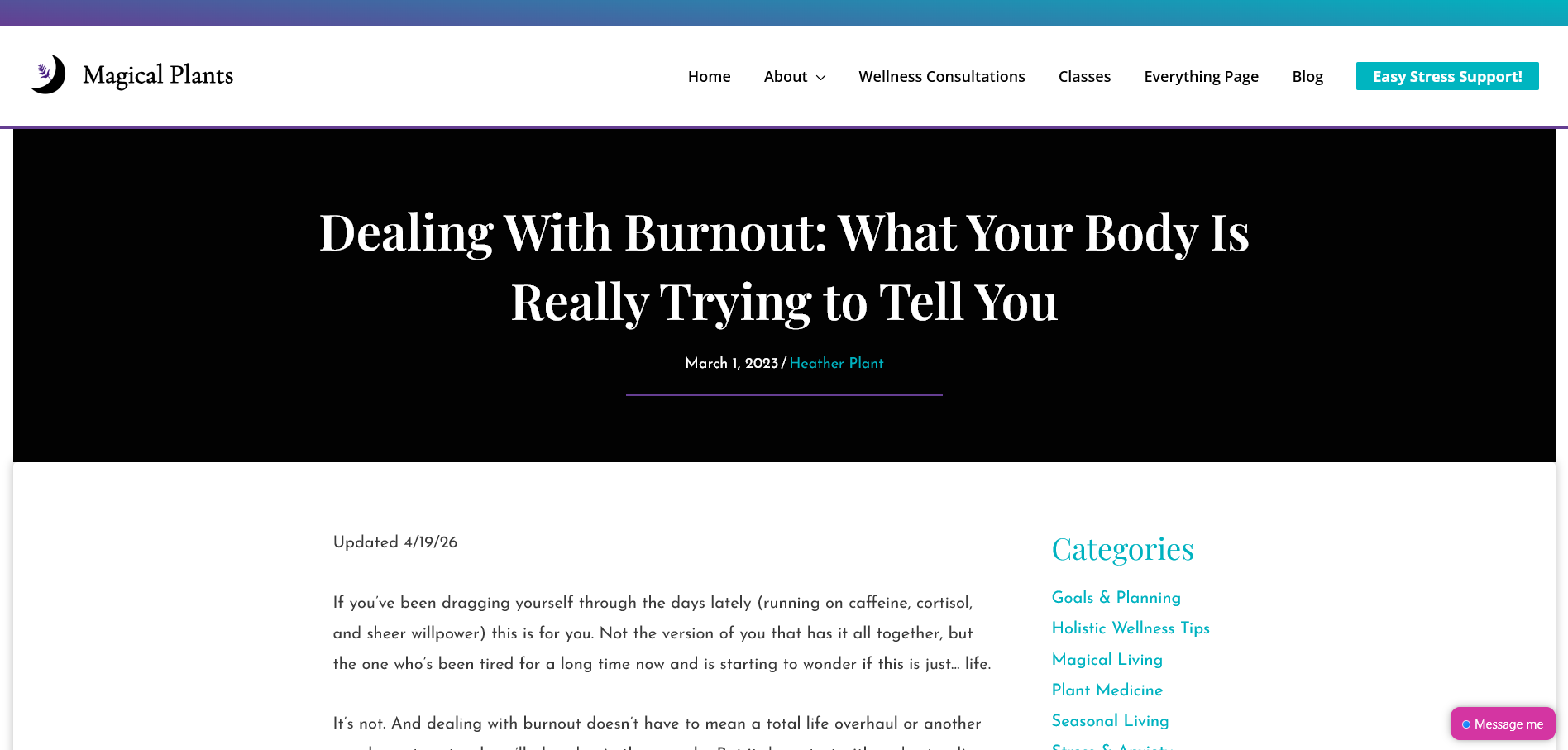
Heather overhauled her burnout post from the ground up — new SEO settings, a stronger meta description, a rebuilt structure, and a proper CTA. Short and honest summary from Heather: “So much better. I was ready to delete the old version.”
That says a lot. A post that was close to being scrapped is now doing work.
How to Approach Your Own Blog Refresh
If you’re looking at your own archive right now and feeling a little overwhelmed, that’s a normal response. Most established blogs have dozens of posts that could use attention, and you’re not going to fix them all at once.
A practical starting point is to pull up your Google Search Console (or Google Analytics / Fathom Analytics if you haven’t set up Search Console yet) and look for posts that are getting some impressions but a low click-through rate. These are pages that Google already knows about and is showing to searchers — but something about the title or meta description isn’t compelling enough to earn the click. That’s a very fixable problem, and it’s a much better use of your time than trying to rank a brand-new post from zero.
From there, pick one post — just one — and work through the checklist: keyword focus, header structure, internal links, images, CTA, meta description. Notice what changes when you actually read it with fresh eyes. Most people find that their older posts needed a lot more than they expected, and that the refresh took less time than they feared.
The students above did this inside a single Get It Done Week, with community support and accountability built in. You don’t need a week to start, though. You need one post and an honest audit.
Final Thoughts
Refreshing old blog posts is one of the most underrated strategies in organic marketing. You’re not building from scratch — you’re improving something that already exists, already has a URL, and already has some relationship with search engines. The ceiling on what a single refreshed post can do is genuinely high, and the work is more contained than writing something new.
The five students featured here made real, specific improvements and came away with posts they’re actually proud to share, link to, and send traffic toward. That’s the goal. Content that works quietly in the background, sending the right people to the right offers, long after you’ve moved on to the next thing.
If you want a space to do this kind of focused, accountable work with other introverted entrepreneurs every month, the Introvertpreneur Club is where that happens. Get It Done Week runs monthly, there’s a supportive community to keep you moving, and the strategy support is built in. You can learn more and join at https://thetarareid.com/join-the-club.
Frequently Asked Questions
How often should you refresh old blog posts?
There’s no single right answer, but a good rule of thumb is to review your most important posts once a year and update anything that’s outdated — old stats, changed offers, broken links, or outdated advice. Posts that are ranking but not converting are worth refreshing sooner.
Does updating an old blog post help with SEO?
Yes. Google factors content freshness into rankings, and re-crawls updated pages. Improvements to keyword focus, header structure, internal links, and meta descriptions can all lift a post’s performance meaningfully.
What is the difference between AEO and GEO?
AEO (Answer Engine Optimization) focuses on getting your content cited or referenced in AI-generated answers from tools like ChatGPT and Perplexity. GEO (Generative Engine Optimization) is broader — it’s about how AI tools understand and represent your entire brand. Both build on a strong SEO foundation.
What should I fix first when refreshing a blog post?
Start with the keyword focus and meta description, since those affect whether your post appears in search and whether people click through. Then move to header structure, internal links, and the CTA. Images and alt text are worth addressing too, especially if the post currently has none.
Do I need to rewrite the whole post when refreshing it?
Not always. Some posts need a full rewrite because the content is too outdated or off-brand to salvage section by section. Others just need structural improvements, link updates, and a better CTA. Reading the post with fresh eyes will usually make it clear which situation you’re in.
Can refreshing a blog post hurt my rankings?
It’s unlikely if you’re improving the content. The main risk is changing a URL (slug) that already has search authority — so unless the current slug is genuinely unusable, it’s usually better to keep it and just improve everything else on the page.
What is Google Search Console and do I need it?
Google Search Console is a free tool that shows you how your site is performing in Google search — which pages are indexed, what keywords they’re appearing for, and how many clicks they’re getting. It’s one of the most useful free tools available for bloggers and online business owners, and yes, you should set it up if you haven’t already.

Tara Reid is a business and marketing strategist for introverted and multipassionate entrepreneurs. She has been an online entrepreneur since 2007 and left social media completely in 2022, growing her business instead through SEO, blogging, email marketing, Pinterest, evergreen funnels, and collaboration. She helps coaches, course creators, and service providers grow sustainable income without performing for an algorithm.
As the founder of the Introvertpreneur Club, Tara’s mission is to show heart-centered entrepreneurs that you don’t have to be loud to be successful. You just need the right strategies that fit your personality.
When she’s not supporting clients or creating new resources, you can find her at home in Canada with her three rescue dogs, a cup of coffee in hand, dreaming up her next project.




This one's on me. Complimentary free stuff coming right up.
leaving so soon?
Look behind the curtain and see exactly what I do every week, month, and quarter, to market my business without social media (in under 5 hours per week)!
The Quiet Marketing Playbook

Take this free quiz and learn what your superpower is as an entrepreneur. You'll also get a curated list of my best resources and tips for using your superpower to your advantage!
What's your Introverted Superpower?

Best Free Resources:
dig into 'em now!